
By: Linda
S. Burke
Ontonagon Elementary School
Ontonagon, MI
Email: teburke@up.net
Teaching
unit implemented November 11 – 27, 2002
Subject: Cross-curricular to include ecology,
chemistry, health, math, social studies, and art.
Grade Level: sixth grade students
Purpose: (1) To raise student awareness of the
presence of mercury and other contaminants in Lake Superior, as well as what
affects these contaminants have on fish, birds, game animals, and humans. (2) To facilitate student understanding of
the relationship between toxins released in our environment and toxins found in
living organisms. (3) To elicit student interest and involvement in the
protection of Lake Superior’s waters, along with its inhabitants.
Overview: Students viewed portions of Michigan at Risk
videos concerning mercury contamination of the environment. They surveyed local sports fishermen to
determine their privately-held opinions regarding the seriousness of mercury
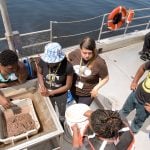
contamination. Students examined Lake
Superior water quality, using a Hach test kit. Next, they learned about
“bioaccumulation” by playing “Food Chain Tag.”
Students viewed a demonstration of groundwater contamination that
utilized a Groundwater Kit. Finally,
students created colorful 9”x12” posters, promoting consumption advisories for
sports fish. Throughout the unit,
emphasis was on students asking scientific questions, doing internet research,
and exploring possible solutions as a group.
Estimated Time
Commitment: Minimum 8 class periods;\,
more time would be preferable.
DAILY ACTIVITIES
Day One
Materials: Students needed binders with pockets to hold
the handouts they received.
Could there be more to
the “Mad Hatter” of Lewis Carroll’s Alice
in Wonderland than just an amusing characterization? In Victorian England, workers who manufactured
men’s fashionable felt hats from beaver skins were known to behave
erratically. Perhaps, their mania was
explained by the fact that mercury was liberally applied when processing the
skins.
Teacher
introduced the unit by presenting a brief history of the six most-cited mercury contamination incidents: 1953, Minamata, Japan where 111 people died
or suffered from nervous system damage after daily consumption of mercury contaminated
fish; 1965, Niigata, Japan where 120 people were poisoned after daily
consumption of mercury contaminated fish;
1970, Alamogordo, New Mexico, where a farm family was poisoned by eating
pork from a pig that had been fed methyl mercury treated grain; 1971-72, Iraq,
where 6,530 persons were hospitalized and nearly 500 people died following
consumption of bread made with grain that had been treated with methylmercury
fungicide; 1980’s Quebec, Canada, where offspring of a Native American couple,
subsisting on mercury-tainted fish, suffered convulsions, visual defects,
blindness, severe mental/physical retardation, infant mortality, and premature
death. 1995-96, Faroe Islands study of
children from a fish-eating population, showed high methyl mercury exposure
levels.
ADDITIONAL TEACHING RESOURCES
http://www.kdhe.state.ks.us/mercury Kansas Department of Health and Environment
http://157.98.13.103/docs/1996/104-8/focus.html Focus:
Environmental Health Perspectives
http://www.co.mo.md.us/services/dep/Health/mercury.htm
http://www.dartmouth.edu/~rpsmith/Heavy_Metals.html
http://www.state.ma.us/dep/files/mercury/hgch2.htm
http://www.the-cma.org.ukhtml/hatter.htm
The
Great Lakes: Environmental Atlas, USEPA, 1995,
pages 30-32.
Distribute
handout showing the body systems affected by mercury poisoning in both man and
animals. Waldbott, G.L. Health
Effects of Environmental Pollutants, 2nd ed. St. Louis, MO, 1978 and Newman, J.R. Effects
of Air Emissions on Wildlife Resources U.S. Fish and Wildlife Services
Program, 1980.
After viewing portions of Michigan at Risk videos,
teacher led a classroom discussion of the following questions:
(1) Do you think there have been other instances of mercury
poisoning that were not reported? Why?
or Why not? Possible responses might
be: (a) there is a delay time for symptoms to become prevalent, (b) communities might not understand what is
happening or might not share problems, (c) developing countries might not
disclose information, preferring to profit from industrial development.
(2) Do you think, knowing the disastrous affects of mercury
poisoning, people are still
stonewalling
efforts to reduce mercury emissions from industry? Teacher will relate story of
Wisconsin’s
commitment ( June 2002) to cut mercury emissions by 90% over the next 15
years. Also, relate how supervisors of
Wisconsin’s state-run coal-burning power plants loudly protested the stringency
of the goal. For more information see Great
Lakes Directory, 5/15/02, Craig Minowa , http://www.greatlakesdirectory.org/mn/051502_econews.htm
HOMEWORK ASSIGNMENT FOR DURATION
OF UNIT: Each evening students will
contact one person who sport fishes in the Great Lakes. Students will use the following form to
record answers to the survey questions.
They are to make the survey experience as objective as possible by NOT commenting
on the participants’ answers. The
participant is to remain anonymous.
However, students must avoid duplication by asking the person if they
have already responded to this survey with another student in the class.
Interviewer’s Name___________________________________________
Interview Date _____________
2002
SPORTS FISHING SURVEY
1.
What lakes or streams does
the participant fish most often?
2.
How frequently do they go
fishing? Daily? Weekends? Summers only?
3.
How many years have they
fished in the U.P.?
4.
What kind of fish do they
like to catch?
5.
Does the participant usually
eat their catch or release it?
6.
How often do they eat their
catch? Once daily? One meal a week?
Two
meals a week?
Other responses ___________________________
7.
Has the participant noticed
any changes in the fish over the years that they have been fishing?
a)
Changes in the number of
fish available?
b)
Changes in the variety of
fish available?
c)
Changes in the size of
fish they have caught?
d)
Changes in the behavior of
the fish they have caught?
8.
Has the participant read the
state fish consumption advisories stated on the back of their fishing license?
9.
Has the participant heard
about mercury contamination of Great Lakes fish?
10. What is their personal opinion about the seriousness of the
threat of mercury contamination?
____
No truth to it! Our lakes are too
remote to get polluted.
____
Don’t know?
_____It’s
a problem that can be dealt with by proper cooking methods.
_____It’s
a very serious problem with no solution.
It is no longer safe to eat fish.
Additional
comments______________________________________________________
11. Is mercury contamination a real threat to anglers who fish
Lake Superior? _____ Yes ____No
12. Is mercury contamination a threat to anglers who fish the
inland lakes of Michigan’s Upper Peninsula? __Yes __ No
Day 2
Teacher divided the class
into four research groups. Students
answered the questions on the Mercury Learning Guide by going to suggested
internet sites. One group at a time met
with the teacher at the front of the class.
There, water samples taken from Lake Superior were analyzed using a Hach
test kit.
Day 3
Students continued with
internet research into mercury. When
all the worksheet questions were answered, students discussed and shared their
answers. This activity was extended
into the real world by reading and discussing the article, “Should Michigan alter water, air pollution
laws?” by Rita Jack and Robert
Fenech. The Detroit News, April 14, 2002, page 15A. This commentary debated two views, one held
by a Sierra Club director and the other held by the senior vice-president of
nuclear, fossil and hydro operations for Consumers Energy in Jackson,
Michigan. Another article detailing
children’s exposure to mercury was also discussed (Wisconsin Department of
Natural Resources, pgs. 15, 16).
Day 4
Contaminants are measured in
‘parts per million’…For example, a scientist might say that a coho salmon has 8
parts per million of PCBs. This would
mean that if you divided the fish’s weight into a million parts, 8 of those
parts would be made up of PCBs…The U.S. Food and Drug Administration sets
limits on the amount of contaminants that can be in a food product to be
sold. The state public health
department issues advisories for personal consumption of fish.
Distribute worksheet with one
million dots. Have students draw a
circle around those dots to represent consumption advisories for mercury levels
in fish. Draw a blue line through the
middle of one dot to represent a mercury level of .16 to .65 parts per million
in fish that may be eaten once a week.
Draw a orange circle around two and one-half dots to represent a mercury
level of .66 to 2.8 parts per million
in fish that may be eaten at one meal a month. Draw a red circle around three dots to represent a mercury
level of more than 2.8 parts per million in fish. These fish should not be eaten.
To place this matter in perspective, have students draw a black circle
around ten dots to represent the methyl mercury contamination of 10 parts per
million in fish that were found responsible for Japan’s Minamata poisoning
incident.
“Most inland lakes in
Michigan, northern Wisconsin, Minnesota, and Ontario have at least some species
of fish with mercury levels exceeding 5 parts per million level. Species of fish include rock bass, perch,
crappie, large and small mouth bass, walleye, northern pike, and muskie.”
(“Michigan Waters and Their Fish: Are
They Safe to Eat?” by Cathy D. Hoffman).
Asked students: If this statement
is accurate, should any U.P. angler eat their catch? How does Hoffman’s statement impress you? Would you change your fishing habits or stop
fishing?
According to the U.S.
Department of the Interior, “Mercury is not like PCB’s, dioxins and other
contaminants. Mercury concentrates in
the muscle tissue and cannot be filleted or cooked out of game fish.”
http://water.usgs.gov/wid/FS_216-95/FS_216-95.pdf Asked students: Why
would this make mercury a bigger problem than PCB’s which concentrate in the
fat of a fish? Answer: Fat can be cut away before cooking
fish. Fish can be broiled to further
reduce contaminants.
As a class, students computed
parts per million with the formula provided in The Life of the Lakes, pg.32. Students played “Food Chain Tag” (Great
Lakes Aquarium, pg. 74-76) for the last 10 minutes of class in the gym.
Day 5
Class divided into four
groups. Each group listed “The Ten Most
Important Facts” about mercury/mercury pollution/mercury toxicity. No more than 10 facts total were accepted
from each group. Students utilized
environmental texts, EPA publications, and Internet sites to develop their
list. Twenty-five minutes were allowed
for this activity.
Students returned to the
classroom mode. Lists were discussed
and compared. How did the group decide
on a particular item to include? Were
there any other items that should have been considered on the lists, but
weren’t?
Teacher put her “Top Ten”
list on the overhead for comparison. Given the validity of these facts, what
could students do to alter the situation?
Teacher assisted students in generating an involvement list.
Assessment: Teacher compared group lists to the teacher
list. Groups who matched the teacher’s
list, item for item, scored higher than those who failed to recognize the significant
concepts of this unit. Of course,
teachers need to use discretion and be open to student viewpoints.
Time remaining in the hour
was used by students to brainstorm ideas for
9”x 12” posters. Posters were
assessed for design and attractiveness.
Inland lakes’ anglers should be advised to catch and release. (These
posters should be laminated if they are to be placed outdoors. Ask permission of the MDNR before posting at
fishing sites.)
Day 6
Teacher distributed MDNR
handouts:
Contaminated
landfill sites in Michigan
Contaminated underground storage sites in Michigan
Class discussed groundwater
risks in our community. Teacher
utilized the groundwater model to show how contaminants can move into streams
and lakes. Class brainstormed what could
be done to reduce the mercury problem in our community.
Day 7
Teacher tabulated the results
of the fishing surveys. Class discussed
the answers given by local fishermen.
Students drew individual graphs that compared the kinds of fish caught,
the number of fish caught, and the number of fish eaten. Students then compared their survey findings
to charts in The Life of the Lakes, pgs
72 & 73. As a class, they developed
a statement that conveyed the general awareness and attitude toward mercury
contamination held by fishermen living in the Lake Superior basin.
The class began to make 9” x 12” posters to inform fishermen of the
lake advisories.
Day 8
Quiz given to assess
students’ knowledge and understanding.
After the quiz, students finished their posters.
MICHIGAN SCIENCE BENCHMARKS ADDRESSED:
C I.1.1 Generate scientific
questions about the world based on observations.
C I.1.3 Use tools and
equipment appropriate to scientific investigations.
C I.1.5 Use sources of
information in supporting scientific investigations.
R II 1.1 Evaluate the
strengths and weaknesses of claims, arguments and data.
R II 1.5 Develop an awareness
of and sensitivity to the natural world.
LEC III.5.6 Describe ways in
which humans alter the environment.
RESOURCES CONSULTED
REFERENCES
Botkin, Daniel B., Keller, Edward
A. Environmental Science: Earth As A Living Planet, John Wiley
& Sons, Inc., New York, NY, 2000.
Bryan, Dr. Virginia, Burbank,
Allen, Ballinger, Dr. Jack. Rivers Curriculum Guide: Chemistry. Dale Seymour Publications, 1997.
Canada Today, vol 12, no.2, 1981, “How Many More Lakes Have to Die?”
Connor, J.J. “Potential pathways for toxic elements to
become concentrated in plants, animals, and humans.” U.S. Geological Survey
Circular 1033, page 61.
Dann, Shari L., PhD., The
Life of the Lakes: A Guide to Great
Lakes Fishery Education Materials, Michigan Sea Grant Extension, Department
of Fisheries & Wildlife, Michigan State University, Lansing, Michigan
Dale Seymour Publications,
“How Big Is a Million?”, Student Sheet 2, 1997.
Edelstein, Karen, Trautmann,
Nancy, & Krasny, Marianne, Watershed Science for Educators,
Cornell
University.
Great Lakes Aquarium, Lake
Effects: The Lake Superior Curriculum
Guide for Grades K – 8. Duluth, MN Pgs.
74-76.
Hoffman, Cathy D., “Michigan
Waters and Their Fish: Are They Safe to
Eat?”
Jack, Rita; Fenech, Robert,
“Should Michigan alter water, air pollution laws?” The Detroit News,
April 14, 2000, page 15A.
Jacobson, Cliff, Water,
Water Everywhere, 1991, “Water Quality Factors Reference Unit,”
“Student
Reading Unit About Water
Quality,” “Teacher’s Guide and Experiments.” Hach Company.
Monson, Bruce A., A Primer
on Limnology, second edition, 6/2000.
The University of Minnesota
Extension Service, St. Paul,
MN.
National Atmospheric
Deposition Program/National Trends Network, 1997, “pH of precipitation over the
United States in 1996.”
Newman, J.R., Effects of
Air Emissions on Wildlife Resources, U.S. Fish and Wildlife Services
Program. 1980. Known sites of effects of some major pollutants in wildlife.
Shaw, Byron, Mechenich,
Christine, and Klessig, Lowell. Understanding
Lake Data. 2002. University of Wisconsin Extension Service, Madison, WI.
United States Environmental
Protection Agency, The Great Lakes:
An Environmental Atlas and Resource Book, Third Edition 1995,
Chicago, Illinois.
Waldbott, G.L. Health Effects of Environmental
Pollutants. 2nd ed.
Mosby, St. Louis, MO. 1978.
Williamson, “Generalized
circulation of the atmosphere,” Fundamentals of Air Pollution, 1973.
WEBSITES
The Canadian Marketing
Association, http://www.the-cma.org.ukhtml/hatter.htm
The Complementary Medical
Association, http://www.the-cma.org.uk/HTML/hatter.htm
Dartmouth College, http://www.dartmouth.edu/~rpsmith/Heavy_Metals.html
ETeach.net, “Assessment
Rubrics” by curriculum project for Members, “Oral Presentation”
http://www.eteach.net/storyprint.cfm?id=22
Focus: Environmental Health Perspectives http://157.98.13.103/docs/1996/104-8/focus.html
Great Lakes Aquatic Habitat
News, http://www.glhabitat.org/news/glnews94.html
Great Lakes Directory, http://www.greatlakesdirectory.org/mn/051502_econews.htm
Kansas Department of Health
and Environment http://www.kdhe.statte.ks.us/mercury
Keweenaw Interdisciplinary
Transport Experiment in Superior (KITES),
http://kites.chemistry.mtu.edu/KITES/maps/harrington.html
Lake Superior College,
Environmental Science Department,
http://www.ilec.or.jp/database/nam/nam04-15.gif
Lake Superior Binational
Program, www.on.ec.gc.ca/glimr/lakes/superior
Montgomery County, Maryland
Department of Environmental Protection,
http://www.co.mo.us/services/dep/Health/mercury.htm
The State of Massachusetts
Department of Environmental Protection, 1996
http://www.state.ma.us/dep/files/mercury/hgch2.htm
The State of Michigan
Department of Environmental Quality
http://www.deq.state.mi.us/erd1sites/indexjsp
http://www.michigan.gov/deq/0,1607,7-135-3585 4127 4175-35420—CI,00.html
**The State of Minnesota
Mercury Website www.pca.state.mn.us/air/mercury.html
The National Center for
Environmental Research,
http://es.epa.gov/ncer_abstracts/grants/99/mercury/brown.html
Pacific Northwest National
Laboratory, http://www.pnl.gov/er_news/08_9/art2.htm
The State of New Jersey
Department of Environmental Protection, http://www.state.nj.us/dep/dsr/vol2-Chapter6.htm
St. Louis River Citizens
Action Committee, http://wwwstlouisriver.org
Synapse, Univ. of California,
San Francisco., http://www.ucsf.edu/~synapse/archives/apr06.00/beal.html
UniSci Daily University
Science News, http://unisci.com/stories/20012/0416013.htm
UniSci Daily University
Science News, http://unisci.com/stories/20021/0319023.htm
“Why Mercury Levels in Water Don’t Equal Levels in Fish”
United States Environmental
Protection Agency http://www.epa.gov/glnpo/sediment/gpra/index.html
http://www.epa.gov/mercury/index.html click on “publications”
United States Environmental
Protection Agency www.epa.gov/glnpo/p2/mercpam.html#Table
University of Texas Marine
Science Institute
http://wwwutmsi.zo.utexas.edu/staff/thomas/research.htm#Environmentaltoxicology
U.S. Department of the
Interior http://water.usgs.gov/wid/FS_216-95/FS_216-95.pdf
Wisconsin
Natural Resources Magazine http://www.wnrmag.com/stories/1998/feb98/mercury.htm
VIDEOS
“Michigan at Risk:
Betrayal of the Great Lakes,” 1991. Michigan State University,
Lansing, MI.
(30 minutes)
“Michigan at Risk: The Not So Great Lakes,” 1991. WNMU-TV, Marquette, MI. (30
minutes)
“Poisoning the Circle: Mercury In Our Ecosystem,” 1993. Great Lakes Indian Fish and Wildlife Commission,
Odanah, WI (12 minutes)
SCIENCE KITS
Groundwater Model and
Educational Materials from Western U.P. Center for Science, Mathematics &
Environmental Education, 105 Dillman Hall, Michigan Technological University,
1400 Townsend, Houghton, MI 49931.
Hach Test Kit and
resources. Water, Water Everywhere
Educational Lab books (especially “Water Quality Factors” ).