
Ruth Ann Smith
Hancock Middle School
Email: ruthann@hancock.k12.mi.u
Unit
Title: Public Beaches & Water Quality
Introduction
Concerns about water quality have been in the news throughout this
past summer. Beaches downstate have been closed due to high levels
of bacteria. The Chicago Triathlon was close to cancellation because
of contaminated water. Our local beaches are heavily used during
summer and our assumption has been that the water is “superior.”
What do we know about the water we are swimming and drinking?
I. Recreation along the Portage Waterway.
-Boating discharge from marine systems
-Run-off from lawns
-Storm water draining into the canal
-Heavy use at the public beaches, especially families with young
children
-Feeding geese at the Chassell beach and dock
-Picnics on the sand
-Tubing and water-skiing around the Waste Treatment facility
Copper Country residents take water for granted with an attitude
“I can use it anytime.” What would you do if a sign
were posted at the Hancock City Bathing Beach, “SWIMMING AT
THIS BEACH IS STRICTLY PROHIBITED DUE TO FREQUENTLY HIGH BACTERIA
LEVELS”? As residents of Hancock, we could wait for the water
at our beach to “clear-up” from contaminants. If a tourist
cannot swim, wade or go near our water, do you think they’ll
be back to visit? Discuss how tourism plays a role in our economy.
What are we known for? Clean air, clean water and beautiful scenery.
What if we can’t guarantee clean water as part of a visitors’
northern experience?
Most metropolitan beaches test water to determine whether it’s
“safe” to swim or even wade in the water. By the year
2004, our Upper Peninsula beaches must also test for harmful organisms.
The Beach Environmental Assessment Closure and Health (BEACH) program
through the Environmental Protection Agency (EPA), has instructed
local communities to develop a plan to check our local beach water
quality and post warnings if our water fails the test.
As seventh grade students at Hancock Middle School, we’ll
look at what this testing means for the future of our area.
II. What are we looking for and how harmful is it?
Definition of terms:
Pathogens
Fecal Coliforms
Gastroenteritis
E. coli (Escheriscia coli), “Don’t we already have this
in our bodies, then why is it harmful?”
Discuss what a medical staff person looks for when they see an
outbreak. Does a doctor have to report this and to whom?
A logical tie-in would be a guest speaker from the emergency room
talking to the class about contagious diseases. Dr. Kirk Lufkin
may be persuaded to speak to our students.
III. Let’s test our water.
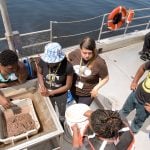
Demonstrate to students the water sampling techniques we’ll
be using. Divide the students into groups of 5 and select one representative
from each group who’ll be transported to a testing site. Sampling
at these sites will be arranged throughout the week. A notebook
will accompany each student to the site, with the student filling
in categories of: time, weather conditions, temperature of water
and air, description of site, and photographs will be taken during
the actual sampling procedure. These students will report to the
remainder of their group about the site.
Testing Sites:
Hancock City Bathing Beach
Houghton City Beach
Chassell Beach
Water Treatment Facility discharge pipe
Swimming pool at the Super 8 Motel in Houghton
Distilled water used as a control
In the middle school science lab, another member of the group will
administer the Coliform bacteria test from LaMotte laboratories.
This test is fairly basic using test tubes containing an indictor
tablet and a color comparison chart. The samples must incubate for
48 hours before results will be seen. Other demonstrations will
be shown using a BRITA water filter and a PUR water purifying filter
for backpacking. Discuss each of these systems for use in drinking
water purification.
IV. Possible sources for E. coli
(geese, duck and animal droppings in the water and along the sand,
leaking diapers, over burdened water treatment facilities especially
after heavy rains)
Test results:
What do we find? What might change these results?
-Testing in late October, not in August
-Geese are gone, animal droppings not as prevalent
-Warm weather helps bacteria grow
Lab reports with water samples will be displayed in Middle School
library for all classes to observe.
V. Who cares about these results?
Public Health Records and public awareness.
Student groups will receive a packet containing several articles
and graphs about epidemics, beach closures, contaminated food recall
notices, and medical information about the effects of E. coli. Each
student in the group will read an article and report their information
to the others. The groups will develop a set of questions for the
guest speaker.
Guest Speaker:
Director of Public Health, Dr.Gail Shebuski or
Houghton County Sanitary Engineer.
Points to cover by speaker:
What is the Public Health Department and what are their careers
about? Specifically, what is the procedure for dealing with epidemics
whether it’s E. coli, West Nile Virus or Influenza? The timing
of the speech should coincide with the annual flu immunization program
promoted by the Health Department (November.) The local media will
be notified about the speaker and the Public Health Department will
benefit from the added publicity.
VI. Final assessment
1. Students will be given a scenario to write about individually.
(Attached)
2. Each group will design a sign for posting at the public beach
explaining water quality status
OR each group will design a page for the City of Hancock web site
about the water quality status at the public beach.
Extra credit: Presentation to City Council meeting, County Commissioners
meeting or Public Health Department.
Teaching Objectives
Completion of this unit will provide students with an understanding
of:
Water quality
Techniques for water sampling
Laboratory analysis
Awareness of governmental departments:
Federal- EPA
State/County- Western Upper Peninsula District Public Health Department
Local- City Council and City Water Department
Historical knowledge about epidemics
Encourage involvement toward improving public health
Extensions:
Tour of Waste Treatment Facility
History of Local Epidemics
Influenza Pandemic of 1912
Research T.B. Sanitarium on Houghton Canal Road
West Nile Virus
Students make microscope slides of mosquitos
Bibliography
Bourdain, Anthony. Typhoid Mary. New York: Bloomsbury, 2001.
Hoff, Brent, and Carter Smith III. Mapping Epidemics. New York:
Grolier, 2000.
Kolata, Gina. Flu. New York: Farrar, Straus and Giroux, 1999.
Rhodes, Richard. Deadly Feasts. New York: Simon & Schuster,
1997.
Spielman, Andrew. Mosquito. New York: Hyperion, 2001.
Symons, Dr. James. Plain Talk About Drinking Water. Denver:American
Water Works Assn, 1997.
Ward, Brian. Epidemics. New York: Dorling Kindersley, 2000.
Michigan Content Standards Addressed
English Language Arts Strand
Content Standard 1
Meaning and Communication
Benchmark 5
Content Standard 2
Meaning and Communication
Benchmark 1
Content Standard 3
Meaning and Communication
Benchmark 3
Content Standard 4
Language
Benchmark 1,5
Content Standard 7
Skills and Processes
Benchmark 1
Content Standard 10
Ideas in Action
Benchmark 2
Content Standard 11
Inquiry and Research
Benchmark 1,3
Social Studies Content Strand
I Historical Perspective
Standard 1
V Inquiry
Standard 1
VI Public Discourse and Decision Making
Standard 2
VII Citizen Involvement
Standard 1
Science Strands
I Constructing New Scientific Knowledge
Standard 1
II Reflecting on Scientific Knowledge
Standard 1
III Using Scientific Knowledge in Life Science
Standard 2,5
IV Using Scientific Knowledge in Earth Science
Standard 2
Honorable ______________________________
Mayor of Hancock, Michigan
Scenario
It’s August 12th in the lovely Upper Peninsula of Michigan.
Tourists are filling up all the hotel rooms and restaurants in Hancock.
Temperatures have been in the high 90’s for a week and everyone
is heading to the nearest swimming spot to “cool off”.
Rumors have started about several swimmers experiencing flu-like
symptoms after spending time at Hancock Bathing Beach yesterday.
The Daily Mining Gazette would like to warn the public about this
serious situation but they need some comments from a city official.
You, as Mayor of Hancock, need a plan of action before making a
comment to the newspaper. Remember, you do not want people to panic.
Describe the steps you would take before returning the Gazette’s
call.
Who would you call for advice and why?
|