
|
Contents: Objectives
(Measurable Outcomes) |
Unit
Title: How
Healthy is YOUR Watershed: An Investigation in Watershed Assessment
Subject: Middle School Earth or Life Science
High School Biology or Environmental Science class
Target Grade: Middle/High School students
Unit Overview: In this unit, students will learn how to assess the overall health of their watershed through a variety of classroom and field activities. At the conclusion of the unit, the students will compile a Watershed Assessment and Recommendation report. Students will learn how to delineate a watershed using topographic maps, how to assess the health of the watershed using physical, biological, and water chemistry tests, and how to identify past and current land uses that may cause potential harm to the watershed. The overall goal of this unit is to not only teach students the methods used in watershed assessment, but to help them develop a connection and sense of stewardship towards their local watershed. As an extension, students may conduct a river clean-up, streamside planting, or other community service project to improve their watershed.
Students
will be able to:
Day 1: Introduction to Watersheds
Activity 1: Lake Superior Floor Map (or comparable version) will be used to visually show students a local watershed. We will talk about what a watershed is, how they use the watershed, and how they impact the watershed. The concept of topography will also be introduced as the means of drawing the boundary lines between neighboring watersheds.
Activity 2: Students will be provided with topographic maps of their local area. First, students will be introduced to the symbols and overall organization of the map. Some time will be spent with the students learning how to read the map, though picturing the actual contours may still be difficult for them to do.
Activity 3: Now that each student is familiar with the topographic maps and how to read and interpret them, they will delineate their local watershed. This will be done using the topographic maps. After students delineate the watershed, they will calculate the approximate drainage area of the watershed. Their watershed boundary lines and the estimated drainage area will be compared to actual values found at the USGS Real-Time Water Data website (http://water.usgs.gov/realtime.html)
Activity 4: Each student will be assigned a particular area of the topographic map. They will be required to build a 3-D model of this assigned region out of clay. Students will be given the scale of elevation and relative size to use so that each smaller model can be assembled together to build a large 3-D model of the watershed.
Activity 5: Branching Out! (Project WET Curriculum & Activity Guide, p. 129-132) In this activity, students will use their 3-D model to determine the direction that water would flow from different locations in the model. This will reinforce the watershed boundary lines that the students drew on their topographic maps by giving them a much more concrete visual of what a watershed boundary looks like.
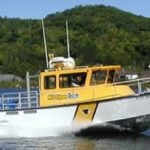
Students will tour their watershed (with guest presenters and resource managers) to observe the topography of the watershed from headwaters to mouth; identify historic and current land and water uses in the watershed; identify possible effects of past and present land uses on the water quality of the river. Using their observations and research, students will develop a hypothesis on the health of the stream/watershed.
Lecture1: Students will be given an introduction to aquatic macroinvertbrates. This will include insect morphology, metamorphosis and life stages, key to macroinvertebrate orders, aquatic habitats in a stream and the role of the organism in the food chain. Students will also be introduced to the use of macroinvertebrates as environmental indicators (see biological indicators’ powerpoint & lecture outline).
Activity 6: Students will practice using a dichotomous key to identify various macroinvertebrates. A Power Point presentation obtained from the MDEQ will be used in this identification exercise due to the high quality pictures it contains. Also, a classroom set of macroinvertebrate specimens, obtained in advance by the instructor, will be used to show students the variable sizes and species of each organism.
Activity 7: Students will be introduced to the chemical and physical sampling processes. The physical sampling consists of habitat assessment as well and stream size, velocity, and discharge. The chemical testing consists of temperature, phosphate, nitrate, turbidity, dissolved oxygen, pH, copper and iron tests. The procedures for each of these tests will be conducted on this day in a laboratory setting to ensure proper procedures will be used when students are in the field.
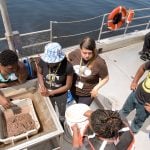
Students will be divided into data collection teams to collect data on: biological, water chemistry, physical and streamside habitat characteristics at a minimum of two different sites on the river. (If possible, students will gather data at another time on a different river, for comparison purposes.)
Activity 9: Each group of students will report their sampling results from the previous day’s field trip onto a group data sheet. Students will discuss their findings in their science logs for use in their written Watershed Assessment and Recommendation Report.
Activity 10: Students will be given aerial photos of their watershed from previous years. They will use these photos, as well as other sources including interviews, old maps, old newspapers, and government websites to identify potential watershed contaminants. Each group will present its findings to the class and all students will record this data in their science logs for use in their written Watershed Assessment and Recommendation Report.
Students will be given this class period to work on their written Watershed Assessment and Recommendation Report. This will be an individual assignment in which the students will report on the data they collected and make a recommendation for future use/restoration of the watershed. Student will use proper laboratory report format for this assignment. This format will already be familiar to the students as it will have been used prior to this assignment.
Students will be assessed in this unit in the following ways:
Middle School Benchmarks
6. Write and follow procedures in the form of step-by-step instructions, formulas, flow diagrams, and sketches.
High School Benchmarks
1. Ask questions that can be investigated empirically.
2. Design and conduct scientific investigations.
3. Recognize and explain the limitations of measuring devices.
4. Gather and synthesize information from books and other sources of information.
Strand II.1: Reflecting on Scientific Knowledge
Middle School Benchmarks
1. Evaluate the strengths and weaknesses of claims, arguments, and data.
2. Describe the limitations of personal knowledge.
3. Show how common themes of science, mathematics, and technology apply in real-world contexts.
5. Develop awareness and sensitivity to the natural world.
High
School Benchmarks
1. Justify plans or explanations on a theoretical or empirical basis.
2. Describe some general limitations of scientific knowledge.
6. Develop awareness and sensitivity to the natural world.
Strand III.2: Using Scientific Knowledge in Life
Science-Organization of Living Things
Middle
School Benchmarks
1. Compare and classify organisms into major groups on the basis of their structure.
Strand III.5: Using Scientific Knowledge in Life
Science-Ecosystems
Middle
School Benchmarks
4. Describe the likely succession of a given ecosystem over time.
5. Explain how humans use and benefit from plant and animal materials.
6. Describe the ways in which humans alter the environment.
High
School Benchmarks
3. Describe general factors regulating population size in ecosystems.
4. Describe responses of an ecosystem to events that cause it to change.
6. Explain the effects of agriculture and urban development on selected ecosystems.
Strand V.2: Using Scientific Knowledge in the Earth
Sciences-Hydrosphere
Middle
School Benchmarks
4. Describe origins of pollution in the hydrosphere.
High
School Benchmarks
1. Identify and describe regional watersheds.
2. Describe how human activities affect the quality of water in the hydrosphere.
Standard 1. Students will read and comprehend general and technical material.
Standard 8. Exposure to different genres of reading and writing to construct and convey meaning.
Standard 11. Define and investigate important issues and problems using a variety of resources, including
technology, to
explore and create texts.
Strand II.2 All students will describe, compare, and explain the locations and characteristics of
ecosystems, resources, human adaptations, envioronmetnal impact, and the interrelationships among them.
(Human/Environmental Interaction)
Strand II.5 (Global Issues & Events)
Strand III (Civic Perspective)
Strand IV.1 (Individual & Household choices)… corresponds with Science III.5
1. Watershed Science for Educators. 2001. Edelstein, K., Trautmann, N., Krasny, M. Cornell University Extension (page numbers provided with daily activity)
2. Project WET Curriculum & Activity Guide. 1995. The Watercourse and the Council for Environmental Education (activity and page numbers provided with daily activity)
3. Aquatic Entomology. 1998. McCafferty, W.P., Jones and Barlett Publishers. (p. 1-90 were used to compile outline and diagrams for student handouts.)
4. WOW! The Wonders of Wetlands. 1995. The Watercourse and the Council for Environmental Education.
5. The Great Lakes An Environmental Atlas and Resource Book, Government of Canada and United States Environmental Protection Agency, 1995
6. USGS Real-Time Water Data Website (http://water.usgs.gov/realtime.html)
7. Terra Server Website, source of aerial photos for most regions of the country (http://terraserver.homeadvisor.msn.com/default.asp)
8. How to Know the Aquatic Insects. 1979. Lemkuhl, Dennis. Wm C. Brown Company Publishers.
9.
DEQ web site to search by County, Pollutant or Source for a list of
contaminated sites: http://www.deq.state.mi.us/erd1/sites/index.jsp
10. Physical, biological, and water chemistry data forms provided by the Western U.P. Center for Science, Mathematics, and Environmental Education at the Watershed Education and Stream Monitoring Workshop, June 11-14, 2002.
Prepared by: Katie Walch (kewalch@mtu.edu), Education Specialist
Joan Chadde (jchadde@mtu.edu ), Water Resources Specialist & Education Program Coordinator
Western Upper Peninsula Center for Science, Mathematics & Environmental Education