Michigan Technological University
Course Coordinator:
Joan
Schumaker Chadde
Western
Upper Peninsula Center for Science, Mathematics and Environmental Education
Michigan Technological
University
Faculty:
Sarah Green, Associate
Professor
Dept. of Chemistry - KITES
Project Coordinator and Director Remote Sensing Institute,
Michigan Technological
University
Matt Julius
Dept. of Biological Sciences
St. Cloud State University
This course is designed to
teach educators about the physical, chemical, and biological components of the
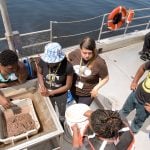
Great Lakes ecosystem. In an exciting week aboard the U. S. Environmental
Protection Agency’s R/V Lake Guardian, participants will have the opportunity
to live and work in the Guardian’s scientific labs beside researchers doing
hands-on data collection and analysis. The course will explore the physical,
biological, chemical, meteorological and geological characteristics of Lake
Superior, by studying and collecting scientific data alongside researchers and
scientists. Mathematics, physical sciences, language arts, and social sciences
concepts will be woven into the experience. Fundamental theory and application
of selected concepts basic to understanding the Great Lakes Ecosystem will be
addressed for the purpose of inspiring effective teaching ideas that
participants can use to incorporate Great Lakes issues in their
classrooms. This intensive interactive
week-long Educators’ Science and Math Institute Series (ESMIS) course is
designed to provide elementary, middle, and high school educators with
standards-based professional development and time to plan, discuss, and reflect
on their teaching.
This course is designed
specifically for K-12 teachers to help them apply Great Lakes science into
their curriculum through both field and laboratory sessions aboard the vessel.
In an effort to help teachers align their teaching units with the Michigan Curriculum
Framework, this institute focuses on
standards and benchmarks that address life and physical sciences. The institute also integrates sessions on
critical reading skills, writing across the curriculum, and other supporting information
from the humanities and social sciences. Institute participants will work
cooperatively in groups sharing their teaching experience and ideas with other
educators. They will have the
opportunity to focus on science and math benchmarks, and adapt new content
knowledge and skills to their specific educational level and situation. ESMIS
provides teachers with the opportunity for real-world inquiry-based experiences
and time to share best teaching ideas with their peers. Selection for an ESMIS
course requires a commitment to actively engage in all learning activities to
optimize the experience for all of the teachers attending.
During a one-week intensive
interdisciplinary experience, K-12 teachers will participate in a field and
laboratory based experience in the Lake Superior Basin. Following introductory sessions on Sunday,
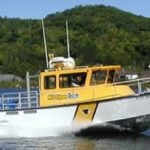
participants will live and work aboard the 180 foot-long R/V Lake Guardian of
the U.S. EPA’s Great Lakes National Program Office, participating in inquiry-based
activities each day. The Lake Guardian
will venture into Superior waters and circumnavigate the Isle Royale
Archipelago while teachers aboard participate in observational and hands-on
research projects. This experience will prepare teachers to help students
understand how parts of an ecosystem are related and how they interact; explain
how energy is distributed to living things in an ecosystem; investigate how
communities of living things change over time; describe characteristics of
ecosystems and the processes that created them; describe how materials cycle
through an ecosystem and get reused in the environment; and analyze how humans
and the environment interact with regard to resources, human adaptation, and
environmental impact. Mathematics, social sciences, and language arts are woven
into an exploration of these concepts.
We will focus on methods to help students to think critically, to ask
questions that help them learn about the real world, to formulate hypotheses
and gather data, and to use evidence in order to make decisions. The knowledge
and experience gained throughout the week are the basis for a teaching unit
that teachers create and implement in the fall. (Science Content Strand I, II, III Standard 5, and V 1-4. Social Studies Content Strand II, Standard
2, 4.)
The content of the institute
will draw on three main resources:
·
Expertise
and innovative approaches of presenters coupled with the firsthand experience
by participants;
·
Teaching
experience and insight of each participant who brings a wealth of knowledge and
creativity to share with each other developing a sense of community and
peer-support which is essential for the success of this institute;
·
Educational
resources, reference materials, and samples of award-winning teaching units
that meet the Michigan standards and prepare students for higher achievement in
science and math while enjoying and learning essential information.
Students have the option
to receive up to four semester hours of graduate credit for the summer
component aboard ship and the fall
practicum component, either through the MTU Department of Education (Educators’ Science and Mathematics Institute
Series (ESMIS) ~ Ecology of the Great Lakes: ED 5601 (3 Semester Credits) Summer 2002
and (tentatively) ED 5602 (1 Semester Credit) Fall 2002, or as an
independent study through their own home institution. Teachers may choose their
own source of credit, depending upon their academic and professional needs.
Each teacher will design a
teaching unit on a topic of her/his interest that models effective teaching
strategies and meets the guidelines of the Michigan Curriculum Framework
Standards. Assessment and evaluation of the Educators’ Science and Mathematics
Institutes Series is provided by the Center for Educational Technology,
Research, and Assessment (CETRA) at Michigan Technological University.
Specific requirements include:
C Attendance and class
participation - All participants are expected to attend all sessions and to
enter into substantive discussion during formal sessions, and in informal
discussions with peers. A field
journal is required during the institute. (30%)
C Best teaching idea - All teacher
participants are required to present a session during the institute on one of
their best teaching ideas. This must be
a well-developed pre-planned presentation for their professional peers
including substantive content, activity description, teaching aids, handouts,
and authentic assessment strategies. (15%)
C Overview of proposed teaching unit -
Participants are provided a reference list and are expected to begin
formulating an idea for a teaching unit in preparation for the institute. Teachers must prepare a one-page written summary
of their idea and be ready to discuss it on the last day of this institute. (15
%)
C Conceptual teaching
unit – Following their one-week course aboard the Lake Guardian, teachers
will design a teaching unit or program appropriate for their teaching level on
a topic of interest related to their experience, and that meets the guidelines
of the Michigan Curriculum Framework Standards or national content standards,
to be implemented in their classroom during the Fall semester 2002. The
teaching unit must be received by August 31, 2002 to receive credit for the
entire course. (40%)
OPTIONAL (for 1 credit):
C Implementation and
evaluation of teaching unit - For the Fall component of the institute
(ED 5602), participants will be required to implement and
evaluate the effectiveness of their teaching unit or program, and submit a
written summary of their experience. The teaching unit should be described in a
manuscript between 1,500 and 2,000 words following the National Science
Teachers Association publication guidelines for Science and Children (elementary), Science Scope, or The Science Teacher (secondary), or
following publication guidelines for enc focus, published by the
Eisenhower National Clearinghouse (enc.org/focus/write). Manuscripts should be
written clearly and concisely, stressing original, innovative classroom
application, with indication of the standards addressed, and meticulous
citations of resources used. As part of the teaching unit implementation,
participants are required to evaluate their students’ learning by an assessment
strategy that must be included in the final paper. The written summary
must be received by Friday, November 29, 2002 to receive 1 hour of semester
credit during Fall Semester, 2002. These teaching units are incorporated into a source that will be
available to colleagues.
Grading Criteria:
Written:
·
Organization
- demonstrates logical flow of ideas and clarity of expression
·
Content
- demonstrates basic understanding of concepts; relevant information
·
Scholarship
- demonstrates analysis and evaluation of ideas; accurate information
·
Style
- conforms to appropriate grammatical, structure, and referencing style
Oral:
·
Organization
- demonstrates logical thinking; coherent, clear, focused
·
Content
- demonstrates comprehensive synthesis of ideas; original and creative
·
Scholarship
- demonstrates knowledge, mastery, critical thinking of select topics
·
Style
- engages the listener, stimulates questions and discussion, respects others
Grading scale is based on
oral and written performance during the week of the institute, preparation of
the teaching unit, and preparation of the manuscript (ED 5602 only).
*Bennett, Thomas R. 1995. Shoreline
Processes of the Great Lakes. Michigan Dept. of Environmental Quality –
Land & Water Management Division – Shoreline Management Unit (Land &
Water Management Technical Report 95-1)
Durbin, William. 2000. My
Name Is America: The Journal of Otto Peltonen A Finnish Immigrant, Hibbing, MN,
1905. Scholastic.
*Graham, Loren. 1995. A
Face in the Rock. University of California Press, Berkeley and Los Angelos,
CA.
*Great Lakes Aquarium. 1998.
Lake Effects: The Lake Superior Curriculum Guide for Grades K-8. Lake
Superior Center, Duluth, MN.
Huber, N. King. 1975.
The Geologic Story of Isle Royale
National Park. Geological Survey
Bulletin 1309. U.S. Government Printing Office, Washington, DC.
*LaBerge, Gene L. 1994. Geology
of the Lake Superior Region. Geoscience Press, Inc. Tuscon, AZ.
*National Science Teacher
Association’s The Science Teacher,
Science Scope, and Science and
Children Writing Guidelines (www.nsta.org
)
*Shaw, Byron, Christine
Mechenich and Lowell Klessig. 2002. Understanding Lake Data. University
of Wisconsin Cooperative Extension.
*U.S. Environmental
Protection Agency and Government of Canada. 1995. The Great Lakes: An Environmental
Atlas and Resource Book
Wetzel, Robert G., 1994. Limnology: Lake and River Ecosystems.
2001. Academic Press.
*These books will be
provided to participants during the institute.
Additional readings will be suggested during the institute.
Great Lakes Information
Network http://www.great-lakes.net/
Great Lakes Environmental Atlas and Resource Book www.cciw.ca/glimr/data/great-lakes-atlas/intro.html
EPA Great Lakes National Program Office www.epa.gov/glnpo
Great Lakes Science Center www.glsc.nbs.gov
Bell LIVE UMD Education http://www1.umn.edu/bellmuse/mnideals/greatlakes/whatbelllive.html
Center for Great Lakes
Environmental Education http://www.greatlakesed.org/directory.html
Michigan DEQ Environmental Education
Michigan Department of
Education. 2000. http://cdp.mde.state.mi.us/science/#Benchmarks
Michigan Curriculum Framework: Interactive Links to Content Strands,
Standards, and Benchmarks.
Understanding Lake Data (a PDF guide) http://www1.uwex.edu/ces/pubs/pdf/G3582.PDF
Water on the Web (University
of Minnesota) http://wow.nrri.umn.edu/wow/overview.html
Contains pdf version of Primer
on Limnology and access to real-time data on Minnesota lakes using robotics
Great Lakes Aquarium at the Lake Superior Center in
Duluth, MN
http://chmac2.chem.mtu.edu/KITES/kites.html
Keweenaw Interdisciplinary Transport Experiment in
Superior (KITES)
Project Coordinator: Sarah Green, Assistant Professor, Chemistry Department,
Michigan Technological University
http://chmac2.chem.mtu.edu/KITES/images.html
Historical and current maps of Lake Superior are
under "other images"
http://www.geo.mtu.edu/~jrbudd/kites/lst93_98/index.html
1993-98 comparison of Lake Superior surface
temperatures
http://www.geo.mtu.edu/great_lakes/lakersi/lars/avhrr_archive/avhrr_archive.html
Index of satellite images for Lake Superior and
other Great Lakes
A Partnership Proposal from Michigan Technological University
1. The Ups and Downs of Lake Superior Water Levels & Shifting
Shores and Eroding Beaches
Dr. Barb McTaggart, PhD, geologist, Western Upper Peninsula Center for
Science, Mathematics and Environmental Education, Michigan Technological
University
Lake Superior is a highly
changeable lake. One of the things that change over time is water levels. These
water level changes can be short term, seasonal, or long term. The reasons
behind these water level changes will be demonstrated and discussed. We will
visit several shoreline sites to see how changing water levels might affect the
shoreline, as well as, how natural processes control shoreline positions, and
how human activities have impacted shorelines. We will visit both eroding and
building shorelines and learn how shoreline property owners can contribute to
shoreline protection efforts.
Ted Bornhorst,
PhD, Professor, Department of Geological Sciences and Engineering
The Lake Superior Basin has a long history beginning about 3.5 billion
years ago. During its history the basin has become endowed with significant
natural concentration of elements such as copper, iron, and gold. The types of
earth materials within the basin are quite varied including many types of igneous,
sedimentary, and metamorphic rocks and unconsolidated glacial deposits.
Participants will learn how the 1 billion-year-old bedrock of the Mid-continent
Rift System has a profound influence on the shape and location of Lake
Superior. Glaciers in the past two million years excavated the Lake Superior
Basin, shaped the bedrock surface of the basin, and left behind numerous
sediments. The geology of the basin plays a major role in the physical,
chemical, and biological environment.
3. Introduction to Biogeochemical Processes in
Lake Superior
Noel Urban,
PhD, Environmental Engineering, Michigan Technological University
Students will assist MTU scientists with a typical
sampling period using a CTD (conductivity, temperature, and depth probe) to
collect data for selected parameters (dissolved oxygen, pH, chlorophyll,
temperature, etc.) from different depths and analyze the relationship of one to
the other. In addition, the use of a
ponar sediment corer will be demonstrated and the core will be analyzed. Data
from Lake Superior will be compared to data typically collected on other Great
Lakes.
4. Micrometeorological Measurements of Air Toxins in the Water and
Water Toxins in the Air
Judith
Perlinger, PhD. Environmental Engineering, Michigan Technological University
How do PCBs and other air
pollutants affect Lake Superior? Students will learn what PCBs are, their
origins, the meteorological processes that bring them to Lake Superior, and why
they are toxic. The presenter will discuss how air pollutants enter the food
chain, how they move in and out of the lake, and their potential impact on the
Lake Superior aquatic ecosystem.
Sarah A.
Green, PhD, Assistant Professor, Chemistry Department, Michigan Technological
University
This presentation will introduce the Keweenaw
Interdisciplinary Transport Experiment in Superior (KITES)
project and the physical, chemical, and biological
processes along the western shore of the Keweenaw Peninsula. This region is the site of a strong,
seasonal current that produces distinct near-shore and off-shore communities in
the lake. This presentation will also address satellite remote sensing of water
properties, thermal and particle remote sensing of the Great Lakes. We will show lake surface temperature maps
and sediment and chlorophyll maps of the lower Great Lakes. Examples include satellite remote sensing of
thermal fronts, changes in sediment concentrations associated with zebra
mussels, and satellite reconnaissance of novel algal blooms.
6. Hands-On Physical Limnology: Temperature, Oxygen & Solar
Radiation
Sarah A. Green, PhD, Assistant Professor, Chemistry Department,
Michigan Technological University
Matt Julius, PhD, Assistant Professor, Dept. of Biological Sciences,
St. Cloud State University
Students will use the ship’s
equipment to collect data on the lake’s summer temperature thermocline,
dissolved oxygen, conductivity, light penetration and its effect on the lake’s
microflora and fauna, and the circulation patterns of water throughout the
year. Students will explore the effect of heat radiation and absorption by the
waters of Lake Superior and its effect on the area’s climate and weather.
Mark Gleason, Director, Isle Royale Institute & Michigan
Technological University
The Lake Superior shoreline has a number of Parks and other public lands located on it. These Parks are popular with the visiting public as well as serving to preserve natural and cultural resources. This presentation will cover the history and resources of two of the USA National Parks that this research voyage will be near. Those two Parks are Isle Royale National Park and Keweenaw National Historical Park. Isle Royale National Park is a group of wilderness Islands located in the northwest corner of Lake Superior. Keweenaw National Historical Park was established to commemorate the upper Michigan copper industry. These two National Parks have significant Maritime Heritage components, which will be part of this presentation.
8. Flora & Fauna of Lake Superior: Phytoplankton, Zooplankton and
Benthic Studies
Matt Julius, PhD, Assistant Professor, Biological Sciences, St. Cloud
State University
Students will assist in
taking phytoplankton and zooplankton tows and using the ship’s lab to identify
organisms. Students will observe changes in numbers over time and at various
depths.
9. Submerged Cultural Resources of Lake Superior
Mark Gleason, Director, Isle Royale Institute & Michigan
Technological University
The waters around Isle Royale National Park contain a wide array of
historical items left from the activities of persons who lived here before we
arrived on the scene. Many items discarded from mining and fishing settlements
and large ships have been found, including dishes and silverware. During this
presentation, we'll discuss the island's submerged cultural resources and
examine artifacts from the Isle Royale museum collection that have been found
underwater. You will hear stories of some of the park's major shipwrecks and
learn how you can explore this underwater 'history book' through recreational
SCUBA diving.
10. Lake Effects—A Lake Superior Curriculum Guide
Joan Chadde, Education Program
Coordinator, Western Upper Peninsula Center for Science, Mathematics and
Environmental Education, Michigan Technological University
Participants will engage in fun, hands-on activities that will bring
the cultural history, geography, and ecology of Lake Superior to life, for them
and their students in the classroom. These activities are linked to national
content standards for science and social studies. Participants will receive a
copy of Lake Effects: The Lake Superior Curriculum Guide that contains
more than 30 interdisciplinary activities.
11. Reading and Writing about the Great Lakes: A Face in the Rock &
other literature
Linda Rulison, middle school social studies and language arts teacher,
Hancock Middle School, Hancock, MI
Ruth Ann Smith, middle school librarian, Hancock Middle School,
Hancock, MI
Participants will explore a
variety of fiction and non-fiction books, and brainstorm lesson plans that will
require their students to use their language arts skills of reading for
information and pleasure, and communicating with others. The presenters will
share the thematic unit that they developed for the Loren Graham novel, A Face in the Rock: Legend, Lore and Loss of
a Culture, as an example, and provide an annotated bibliography.
12. Great Lakes Shipping and Non-Native Invaders in the Great Lakes
Mark Gleason, Director, Isle Royale Institute and David Rockwell, U.S.
Environmental Protection Agency
Over the years, various
activities of humans have led to the introduction of many non-native, aquatic
nuisance species as well as invasive land plants. This presentation will review
several aquatic invaders such as the ruffe, round goby, spiny water flea, and
zebra mussels that have made their way into Lake Superior.