Excursions
on Torch Lake & Portage Lake aboard MTU's Research Vessel Agassiz
FREE for the public this summer at 3 community events
Press
Release (PDF) Poster
(PDF)
The Western U.P. Center for Science, Mathematics and Environmental
Education is partnering with Michigan Tech University to provide FREE
40-minute excursions aboard MTU's research vessel Agassiz at three
community events this summer. Members of the public will be able to
take an excursion on Torch Lake or Portage Lake with an MTU scientist
to learn how the Great Lakes are studied and which characteristics
contribute to healthy lake.
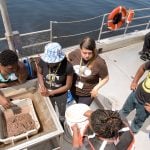
Displays, educational materials, and samples of organisms living
in the lake, as well as sediment from the lake bottom, will be available
for public viewing onshore. Seventeen persons may participate on each
excursion (must be 7 years of age or older). These events are funded
by the Michigan Space Grant Consortium, and Michigan Technological
University's College of Engineering and Department of Civil and Environmental
Engineering.
The three community events are:
(1) Houghton Co. Historical Society's Trains, Tractors, and More History
Extravaganza ~ Noon - 4 pm, Sunday, May 21 at Lake Linden Marina.
Sign up for hourly departures at 1 pm, 2 pm, and 3 pm at the Lake
Linden Marina dock.
(2) Houghton Bridgefest ~ 11 am - 3 pm Saturday, June 17 on the Houghton
waterfront across from Gazette offices on south/east side of Houghton-Hancock
bridge. Sign up for hourly departures at 11 am, noon, 1 pm, and 2
pm at the dock.
(3) Chassell Strawberry Festival ~ 1-4 pm, Saturday, July 8 at the
Chassell boat launch & marina. Sign up for hourly departures at
1 pm, 2 pm, and 3 pm at the Chassell Marina dock.
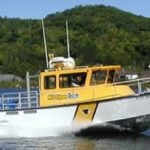
The Agassiz is a 36-foot, aluminum-hulled vessel that was custom-built
to support Michigan Tech’s mission in water quality research
and education. The Agassiz has undertaken scientific research on Lake
Superior with funding from the Michigan Great Lakes Protection Fund,
U.S. Environmental Protection Agency, National Science Foundation,
and others. The Agassiz sails from ice-out (mid-April) through October.
The Agassiz carries the following scientific equipment: Secchi disk,
Temperature probe, Van Dorn water sampler, Portable spectrophotometer,
Phytoplankton & zooplankton nets, and a PONAR sediment dredge.
The Agassiz is also available for educational cruises for middle/high
school students and teachers between May and October of this year.
Classes from many area high schools have had the opportunity to expand
their classrooms to include the waters of Lake Superior and the Keweenaw
Waterway. Students have enthusiastically embraced this unique hands-on
learning experience. Michigan Tech scientists and or graduate students
will lead the excursions.
Cruises may be half-day or full-day in length and take place on eitiher
Portage Lake, Torch Lake, Keweenaw Waterway, and/or Lake Superior.
Water quality conditions in these systems vary both seasonally and
by location, providing a dynamic learning experience. Teachers have
the flexibility to tailor the topical content of each cruise to best
fit their curricula, with options to address biological, chemical
and physical features, or focus on one particular discipline, e.g.
the physics of lakes. Trips aboard the Agassiz may also include demonstrations
of vessel operation, safety and electronic navigation aboard ship,
include a laboratory experience after the excursion, or be combined
with visits to related sites of interest, e.g. a wetland or wastewater
treatment plant, upon request.
Below are examples of topics that can be addressed in educational
cruises, tailored to each age group:
Biological Limnology
A PONAR dredge is used to collect samples of the invertebrate animals
which inhabit the bottom sediments. Samples are processed to separate
the animals from the sediment and the collection is inspected. Plankton
nets sample the phytoplankton and zooplankton that inhabit the open
waters. Stops can be made to conduct shoreline seining of the fish
community. On board discussion focuses on differences in the diversity
of aquatic life in different habitats and the role of invertebrate
animals as indicators of ecosystem health.
Physical Limnology
The physical composition of sediment samples collected with the PONAR
sediment dredge is evaluated. The sand-silt-clay content of the sediment
is compared for sites at various depths. On board discussion focuses
on the role of particle size, density, and their interaction with
wave energy in determining sediment character and the types of organisms
which inhabit various environments.
Chemical Limnology
Depth profiles of dissolved oxygen and water temperature are developed
at several sites using a HydroLab. Vertical structure in oxygen and
temperature is explored as a basis for understanding the significance
of thermal stratification. On board discussion focuses on the interplay
of physics (temperature), chemistry (oxygen), and biology (oxygen
consumption) in determining the oxygen resources of lakes.
For More Information:
Joan Schumaker Chadde, Education Program Coordinator
Western Upper Peninsula Center for Science, Mathematics & Environmental
Education
105 Dillman Hall
Michigan Technological University
1400 Townsend Dr., Houghton, MI 49931-1295
Tel: (906) 487-3341 Fax: (906) 487-1620 Email: jchadde@mtu.edu
Western Upper Peninsula Center for Science, Mathematics & Environmental
Education website: http://wupcenter.mtu.edu/
###